Why This Centre Exists
Experience Compassionate Care at The Patient Approach Cancer & Wellness Centre
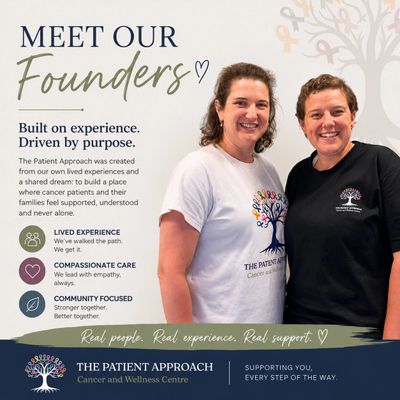
The Patient Approach Cancer & Wellness Centre was founded by Katie Palm and Stephanie Jones after navigating cancer diagnoses as young mothers and experiencing firsthand how difficult it can be to access the right support at the right time.
Throughout treatment, recovery and survivorship, we found ourselves searching for cancer support services across multiple locations, providers and organisations. While excellent healthcare existed, the journey often felt fragmented, leaving patients and families to coordinate their own care during some of the most challenging periods of their lives.
It became clear that there was a need for a more connected approach to cancer support in Brisbane, one where patients, carers and families could access a range of supportive services under one roof.
The Patient Approach Cancer & Wellness Centre was created to bridge that gap.
Our vision is to provide a welcoming space where individuals can access allied health, wellness and supportive care services throughout every stage of their cancer journey, from diagnosis and treatment through to recovery, rehabilitation and survivorship.
While cancer care remains at the heart of what we do, our services are also available to the wider community, including adults and children seeking high-quality allied health and wellbeing support.
As Brisbane's first Cancer & Wellness Centre, we are proud to bring together experienced practitioners who share a commitment to compassionate, patient-centred care and helping people live well during and beyond cancer.

The Founders Story of The Patient Approach
The Patient Approach began with Katie's own experience as a patient.
For many years, Katie and her husband faced infertility, pregnancy loss and the emotional challenges that come with trying to grow a family. Through multiple losses and difficult hospital experiences, she became acutely aware of how unsupported people can feel once they leave the clinical environment. While the medical care was often excellent, the emotional support and practical guidance were frequently missing.
After eventually welcoming two children, Katie's own health journey took an unexpected turn. When her youngest son was just eight months old, she was diagnosed with a rare cancer after months of unexplained symptoms and numerous medical appointments. At the time, she was raising two young children aged three years and eight months, while navigating a diagnosis that would require 12 months of chemotherapy.
Like many patients, Katie quickly realised that cancer impacts far more than physical health. Alongside treatment came a constant stream of appointments, referrals, scans, paperwork, difficult decisions and the emotional weight of trying to hold family life together. While clinicians focused on treating the disease, much of the responsibility for navigating the healthcare system fell to the patient.
Just as life began to regain some normality, another challenge emerged. Less than two years after completing treatment, a PET scan revealed a second rare and more aggressive cancer. This diagnosis led to surgery, 18 months of intensive chemotherapy, extended hospital admissions and 20 rounds of radiation therapy.
Throughout both cancer journeys, Katie experienced firsthand how fragmented supportive care can be. Accessing allied health services, mental health support, peer connection and practical assistance often required navigating multiple organisations, providers and locations at a time when energy and capacity were already stretched thin.
These experiences sparked a simple but powerful vision: there had to be a better way.
Katie began building what would become The Patient Approach with the belief that no patient or family should have to navigate serious illness alone. She envisioned a place where support services were connected, where lived experience was valued, and where patients could access the care they needed in one welcoming environment.
In 2025, Steph joined The Patient Approach, bringing her own lived experience of breast cancer and a shared passion for improving supportive care. Together, they created The Patient Approach Cancer & Wellness Centre, a place built on empathy, understanding and the belief that patients deserve more than treatment alone. They deserve connection, support and a team that walks alongside them throughout their journey.





Our Founder, STEPHs Story
Steph's story is one of resilience, motherhood and finding purpose through one of life's most difficult challenges.
In 2024, Steph's world changed forever when she was diagnosed with breast cancer the day before the birth of her fourth child. What should have been one of the happiest moments of her life was suddenly overshadowed by fear, uncertainty and the reality of needing to start cancer treatment while caring for a newborn baby and three other young children.
As a young mum, Steph often found herself sitting in treatment rooms surrounded by people in very different stages of life. While she was incredibly grateful for the medical care she received, she struggled to find others who truly understood what it was like to be navigating cancer while raising young children, managing a household and grieving the loss of the early motherhood experience she had expected. One of the most difficult realities was having to stop breastfeeding after just one week so she could begin treatment, a decision no new mother ever imagines having to make.
Throughout her treatment, Steph experienced firsthand the emotional, practical and social challenges that cancer brings. She quickly learned that while healthcare teams focus on treating the disease, patients and families are often left to navigate everything else themselves.
Seeking connection with others who understood, Steph was invited by a mutual friend to attend a Mental Health Breakfast hosted by The Patient Approach. It was there that she met Katie. What began as a conversation between two women with lived experience soon revealed a shared vision, a belief that supportive care should be easier to access, more connected, and built around the real needs of patients and families.
Steph was immediately drawn to the peer support and community focus of The Patient Approach. She understood the power of connecting with others who had walked a similar path and the difference it can make during some of life's darkest moments. Together, she and Katie recognised that there was an opportunity to create something truly different.
Today, as Co-Founder and Care Coordinator of The Patient Approach Cancer & Wellness Centre, Steph is passionate about helping others feel less alone. Drawing on both her lived experience and her background in healthcare, she works alongside patients, carers and families to help them access the support, services and connections they need.



Supporting Patients, Families & Carers Across Brisbane
The Patient Approach Cancer & Wellness Centre supports individuals and families from Cleveland, Redlands, Brisbane Bayside and surrounding Brisbane suburbs. Our multidisciplinary team provides cancer support services, allied health care and wellness programs designed to improve quality of life during treatment, recovery and survivorship.